• Fuji X-T50 Review

    I’ve had my Fuji X-T50 with 35mm f2 lens for nearly six months, and I know enough about its handling now to review it.

    The body weighs 438g, which is light considering that it has IBIS and a 40MP sensor.

    And overall I am very pleased with the camera. It doesn’t feel too small in the hand, and controls are very straightforward.

    It hasn’t taken me long to feel I can instantly make any settings I need to aperture, shutter speed, ISO, and exposure compensation without having to sit and remember. The viewfinder shows an icon against each setting to remind you.

    The only thing I forget momentarily is that the lens itself has an aperture dial, so that is where I need to turn the aperture ring to change aperture.

    It’s simple, but there are so many lenses now that do not have an aperture right, that it is easy to forget , if only for a moment.

    The IBIS (in-body-image-stabilisation) works very well and I am very happy with the extra megapixels. My experience is that more megapixels really does improve image quality.

    General Points About APS-C Versus Full Frame

    Compared to full-frame cameras with the same settings, APS-C cameras have more in focus because there’s more depth of field because there’s a shorter focal length for the same angle of view.

    There are plus points and minus points for that compared to full frame.

    Were I to want a shallow depth of field – for portraiture for example – then I would need a lens with a bigger maximum aperture than if I was shooting full frame.

    The focal length and maximum aperture I would need in APS-C to get the same depth of field a full frame sensor with a 50mm f2 lens is a 35mm f1.4 lens. And they are available.

    And the focal length and maximum aperture I would need in APS-C to get the same depth of field a full frame sensor with a 35mm f2 lens would be a 23mm f1.4 lens. And they too are available.

    It’s the same with a full frame 85 mm f2 lens. A 56 mm f1.4 APS-C lens would give the same depth of field.

    So getting a shallow depth of field with an APS-C camera is completely doable.

    Of course, if I had a full frame f1.4 full lens and wanted an APS-C lens with the same depth of field, then we are getting into very wide aperture lenses and they come at a big premium.

    Outside of that, the counter argument is that APS-C lenses have more depth of field for the same f-stop, and for work where more depth of field is wanted – such as in landscapes – then APS-C has the advantage.

    Downsides with the X-T50

    So, is there anything not perfect about the camera?

    It comes down to weight and ease of carry. My Ricoh GR III in a leather carry case slips into a jacket pocket and it weighs so little that I truly can forget I have it with me. That is not so with the XT-50.

    It is not that it is heavy; it is that it is not so light and small that I can forget it. So then the question arises as to whether it is the right size. Specifically, is it big enough to handle a long lens. And it is not, not really.

    I also have a 55-200mm lens, and the body feels too small to balance it properly or to control it on a subject. It’s not terrible, and I have been pleasantly surprised to find that shots I thought had to be misses, turned out to be hits.

    But the experience when shooting with a long lens is not reassuring.

    So then the X-T5, the big brother to the X-T50 starts to appeal. It is not that much heavier at 557g with battery and card compared to 438g for the X-T50.

    And so that question comes down to whether to use the X-T50 as a small carry around and get an X-T5, or whether to sell the X-T50 and get an X-T5 and use the GR III as my carry around.

    Or (there is always an ‘or’) whether to sell the X-T50 and get an X-T5 and also get a GR IIIX which has a 40mm full-frame equivalent lens. Or just get an X-T5 and have done with it.

    First world problems, and as much a part of photography as actually taking photos.
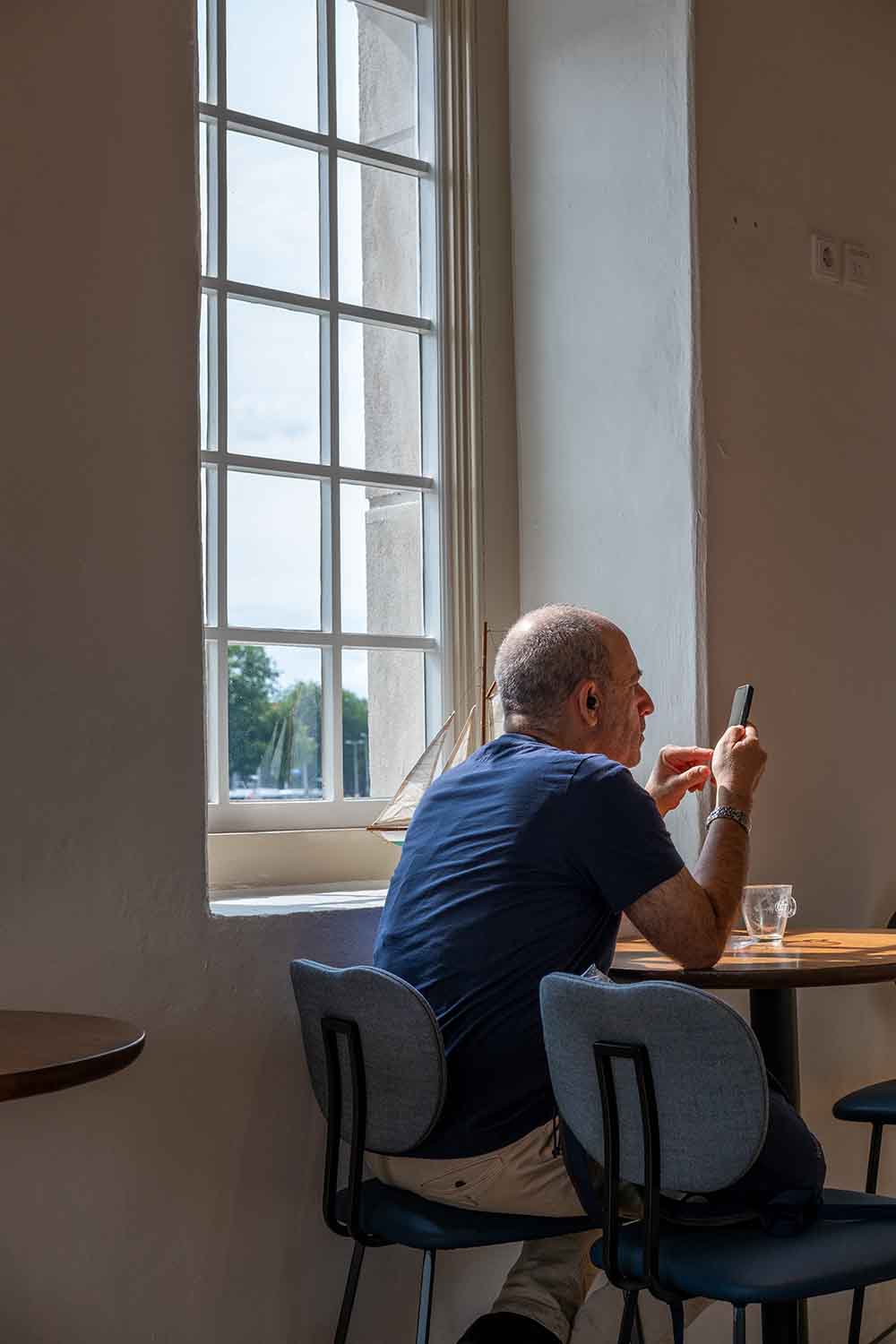

    Any Early Portrait With The X-T50

    Such nice light coming in from the window and what a nice window, tall and letting light in from above. And a pale, neutral colour on the wall. What is not to like as a setup?

    This is the Fuji X-T50 with 35mm f2 lens, and I grew to like it as the days on holiday in Amsterdam wore on because I started to like what came out of the camera. To begin with I was shooting big scenes that were too far away to really show what the camera can do.

    As I was reviewing the shots in the camera I began to see what was working.

    I got the camera specifically as a carry-around and travel camera. I couldn’t put up with using my GRIII for everything because without a viewfinder, and in bright sunlight, I am shooting blind– or at least with less certainty.

    In terms of image quality the X-T50 is of course ‘better’ than the GRIII because it has more pixels. But really it is just different.

    Except I have to give it to the Fuji. For the shots that work, I like it more and after just a few weeks I developed a good feeling for it and started becoming attached to it as a tool.


  • Fx Or Dx And Mastering Filmmaking

    Wex is the UK’s biggest seller of photography related equipment and I was invited to an event they hosted at the British Film Institute in London.

    Tools for Mastering Filmmaking was a day of equipment and talks about shooting video.

    I use my phone for video, but for a number of reasons it is not ideal. At the same time, I don’t want to use my camera for both stills and video.

    The setup I am most attracted to, is one of the one-inch sensor action cameras with a built-in gimbal and remote microphone.

    The focus for the event was on Nikon and its acquisition of the video camera made RED, and the introduction of the Nikon ZR that pairs Nikon hardware with RED technology.

    The guest speaker was Roxy Hemadani, (@roxythezoologist) who gave two talks that she illustrated with her work.

    Apart from the technical information, one thing she said is that stories need heroes and villains.

    I was thinking about that. What is lost by taking out the heroes and villains angle? Everything we feel and detect is from opposites – light and dark, hot and cold, good and bad, etc. And if we take away the good and the bad, then what motivates us?

    Do we become unmoved, emotionally detached because we are designed to be motivated by heroes and villains?

    It’s a question.

    Meanwhile, the model who had been brought in for the day sat and watched from the back of the room. She was there to be the focus for the video cameras set up on tripods, so we could see how good the cameras were.

    We could see how the Nikon ZR Cinema Camera rendered video of her in the screen. With ‘standard’ setting the scene looked nice and warm and natural looking.

    But as someone who has only shot video on my phone, I am not the last word in judging the quality of one video camera against another.

    The ZR does not have an electronic viewfinder (EVF), so actually focusing on something comes down to the autofocus ability of the camera. One of the reasons I like an EVF is that I can point it where I want.

    I guess it takes some getting use to in order to be able to work with video with an EV-less camera.

    It is true that my phone doesn’t have an EVF but neither is it a serious video-making machine.

    No one was paying attention to the model, who sat at the back of the room while the talks were on.

    So I decided to take a photo of her with my Ricoh GRIII, the only camera I brought with me.

    She started to pose as you can see here, and I asked her to just to sit.

    John (a photographer I know from photowalks) came over and joked to us about me liking bare-bones realism and nothing arty.

    She started laugh, and the best two shots would have been great except I had the ISO set too low to capture movement because the light was low.

    I shot at 1/20th of a second at f2.8 and base ISO 125

    To capture movement I should have set the ISO at 800 or 1600.

    ISO 800 would have been almost three stops faster, which would have meant I could shoot at 1/160th second. And that would have frozen the action.

    Ah well.

    FX Or DX

    During her talk, Roxy said the cameras she works with have an inbuilt crop ability, which she uses for extra reach.

    That stuck with me and was part of what prompted me to take the photos of the model.

    I had asked Roxy, which was to what extent she could see a difference in image quality between full frame (FX) and crop sensor (DX).

    She said she could see the difference when she was editing but that most people would not see any difference.

    That’s really a big thing, because it means a photographer could put a 70-200 lens on a full-frame camera and have 300mm at the long end when needed.

    It also means they could use a crop sensor camera and enjoy the benefits of a lighter, smaller package.

  • Fuji 55-200mm on a Fuji X-T50

    In preparation for shooting the New Year’s Day parade, I went out to take some shots with a Fuji 55-200mm lens on a Fuji X-T50.

    I had hardly used the lens and so I wanted to get in some experience rather than find out the shortcomings on the day of the parade.

    The Fuji X-T50 is a 40MP APS-C crop sensor camera. which makes the lens an 82.5-300mm full frame equivalent.

    I have used a Nikon 70-300mm lens on a Nikon D500. That too is a crop sensor camera and equates to 105-45mm full frame, and so reaches even further.

    But the X-T50 has twice the megapixel count of the D500, so the demands on the lens are greater.

    Plus which the X-T50 and the 55-200 have image stabilisation, whereas although the Nikon 70-300 has stabilisation, the D500 body does not.

    So here is what I learned from shooting the Fuji 55-200mm on a Fuji X-T50.

    The X-T50 is a small camera and the lens doesn’t balance well on it.

    Also, the lens extends when it zooms. Closed, the lens is 118 mm long. Fully extended it is 177 mm long. The inner barrel extends out as you zoom out to longer focal lengths. And that changes the balance of the lens.

    Even with the lens collapsed to its shortest length it feels too heavy for the camera. With the lens is zoomed out and extended, it is hard to keep the focus on the person. I felt like I was weaving all over the place and I thought I was going to get blurry shots.

    If the target is big and all in the same plane, then it doesn’t matter if you weave about a bit. But if the target is small and if you miss it you focus on something nearer or further away, then it matters because your shot will be out of focus.

    What I didn’t appreciate is that the IBIS (in-body-image-stabilisation) on the camera works really well. The lens too has image stabilisation. And the two work together.

    The bottom line is that I was surprised when I looked on the computer screen and saw that even though I felt like I was weaving about, the shots were sharp.

    Recommendation

    I think the lens would be more pleasurable to use if it was on a bigger camera body that I could hold steadier.

    While there are older bodies, I suggest it means the Fuji X-T5 or the Fuji X-H2.

    So how do they stack up side by side?

    With battery and card the Fujifilm X-T50 weighs 438g. The X-T5 weighs 557g, and the X-H2 weighs 700g.

    The only features on the Fujifilm X-H2 that are meaningful to me are a better grip and an EVF with 5.76M dots versus 3.69M dots compared to the X-T5.

    However, the extra weight of the X-H2 takes it out of the equation because it doesn’t have other features to swing the balance in its favour.

    The features on the Fujifilm X-T5 versus the X-T50 that are meaningful to me are a bigger EVF with 3.69M dots versus 2.6M dots on the X-T50, and bigger dimensions meaning I can grab hold of the camera and hold it steady more easily. So then the only downside is the extra 219g.

    What’s the answer? I think as a carry-around camera with a short lens, the X-T50 wins. For a longer lens, the X-T5 wins.